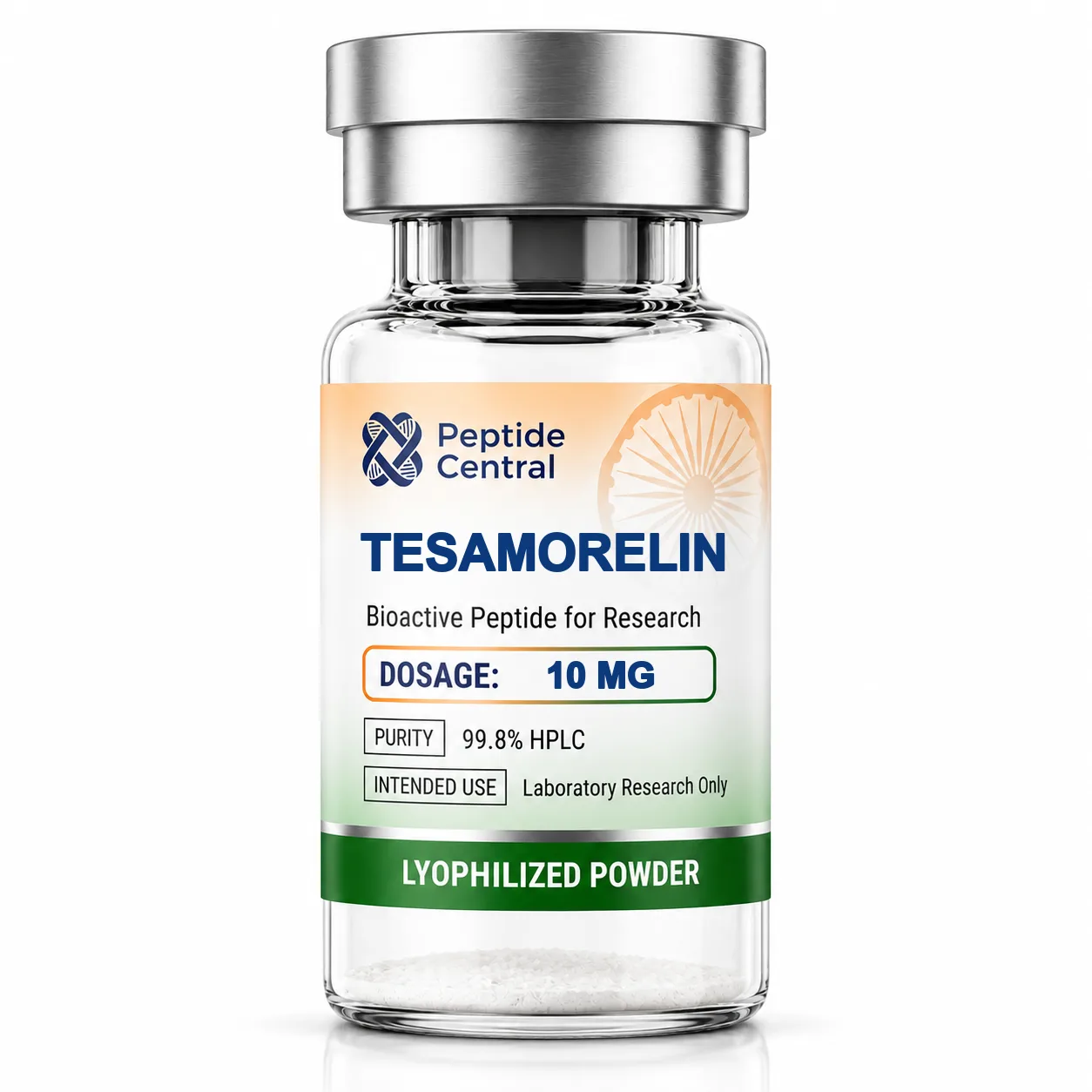
What is Tesamorelin?
Tesamorelin is a synthetic analogue of Growth Hormone Releasing Hormone (GHRH) consisting of the full 44-amino-acid sequence of endogenous GHRH with a trans-3-hexenoic acid group attached at the N-terminus to enhance stability. FDA-approved as Egrifta for HIV-associated lipodystrophy, it has been extensively studied for its ability to specifically reduce visceral abdominal adipose tissue (VAT) without the side effects of exogenous growth hormone administration.
Research Benefits
- Specifically targets visceral abdominal fat (VAT) — proven in FDA-approved clinical trials
- Stimulates natural GH pulsatility rather than delivering exogenous GH
- Improves IGF-1 levels and body composition without supraphysiological GH exposure
- Enhances cognitive function and verbal memory in research on GH-deficient subjects
- Improves lipid profiles — reduces triglycerides and increases HDL cholesterol
- Studied for carotid intima-media thickness reduction — a cardiovascular health marker
Dosage & Protocol
Research protocols use 1–2 mg per day administered subcutaneously, typically in the evening to align with natural nocturnal GH pulses. The short half-life of approximately 36 minutes is manageable with once-daily injection due to its GHRH receptor activation mechanism. Standard research cycles are 12–26 weeks.
Frequently Asked Questions
Both are GHRH analogues, but Tesamorelin is FDA-studied with specific clinical data on visceral fat reduction. CJC-1295 (no-DAC) has a similar mechanism but shorter history of clinical study. Tesamorelin's efficacy for VAT reduction is supported by randomized controlled trial data.
Yes. Tesamorelin stimulates pituitary GH release, which in turn raises hepatic IGF-1 production. Clinical studies show dose-dependent IGF-1 increases. IGF-1 monitoring is recommended in extended research protocols.
Evening administration — typically 30–60 minutes before sleep — is preferred to amplify the natural nocturnal GH pulse. This timing maximizes GH pulsatility and IGF-1 response while aligning with circadian rhythms.